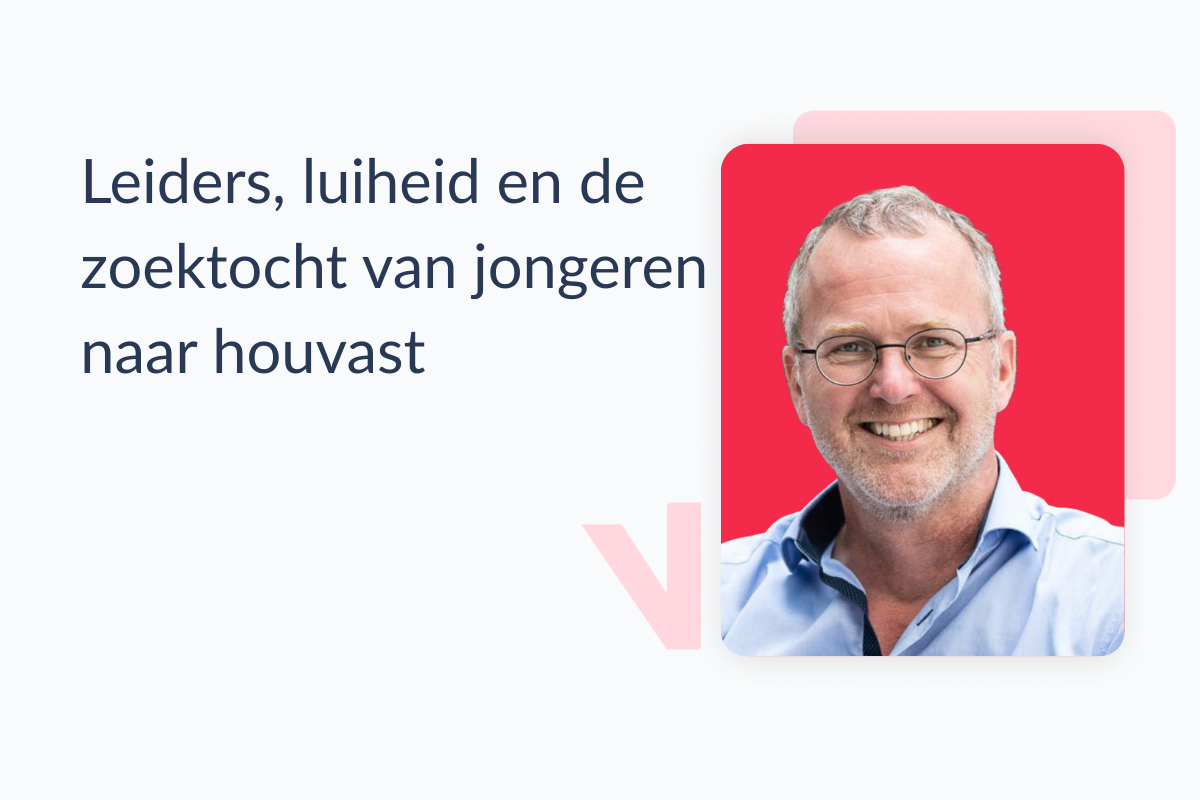


Behavioral biologist Patrick van Veen has a message for leaders: pay more attention to TikTok than to AI. Because if you want to understand young people, you need to know what drives them.
At conferences, everyone raises their hands when asked who is involved in AI. And TikTok? "With a little embarrassment, two or three hands go up," says Patrick van Veen in the podcast De Werkprofessor. According to the behavioral biologist, that's a missed opportunity.
"What I find particularly important is that leaders start thinking about what drives the young new generations." He mentions YouTuber MrBeast, who has 450 million followers. "That person has more power than the average prime minister in a medium-sized European country."
Van Veen founded Apemanagement in 2002, taking management teams to the zoo to hold up a mirror to them. He has written several books on behavior and leadership, including Help, My Boss is a Monkey!, and was chairman of the Jane Goodall Institute Global for five years.
Predictable leaders
Van Veen is clear about young people: their world has become much more complex. "You suddenly find yourself part of many more social groups. Family, friends, hobbies, a professional domain, and a strong online world. All these groups overlap."
This leads to time stress, authority stress (who tells the truth anymore?) and consequence stress (does what you do have any consequences at all?). A striking observation: criminal gangs often have clear norms, values, and rules of conduct. "And they use the online world to recruit young people for this purpose."
Young people are susceptible to this because they seek clarity that has disappeared from the rest of society. At the same time, they see online "the great temptation of everything you should want." Van Veen: "When you combine those two, you have a pretty toxic mix."
Why we follow dictators
In his conversation with presenter Wendy van Ierschot, Van Veen also explains why we follow leaders such as Trump, Putin, and Netanyahu en masse. The answer? "Because we humans are extremely lazy." That sounds harsh, but Van Veen means it in a biological sense. "Humans are programmed to be extremely lazy. If you waste energy, you also have to consume it. So anything you don't have to waste makes life easier."
We choose leaders who we believe will save us energy. "Leaders who are often clear and will solve your problems." Does that actually happen? "That's not important at all. What matters is that individuals trust you to solve problems."
It's all about predictability. That's more important than honesty, Van Veen explains. He gives an example: "You can trust people who never keep their promises very well. Because you know where you stand."
These leaders give the impression that they are predictable. "People think: if I vote for that leader, then I know where I stand for the next four or five years." And if that turns out not to be true? "Then someone else has disrupted that process."
Designed for small groups
This also explains why we often fail to think in broad terms. Van Veen points out that people are not used to thinking in terms of large social structures. ‘We are programmed to think in terms of social structures of 100 to 200 people.’
For many people, it is too complex to think about Europe, technological developments, or what will happen in fifty years' time. "We are somewhat programmed to protect that small territory."
Van Veen also sees this reflected in organizations where collaboration can sometimes prove difficult. "If I make a decision today, it will have an impact on my colleague three departments down the hall. Or in a building down the street. Yes, it has become too complex."
Back to attention and contact
Chimpanzees use childhood to learn norms and values. "These lessons are primarily intended to enable them to survive effectively as adults." According to Van Veen, we forget this. "We have somewhat forgotten the message that childhood conveys. How can we ensure that we will become very good adults?"
His advice for organizations and leaders? "We need to engage in much more dialogue, including with the younger generations. Just have a good conversation with each other."
Three takeaways from the podcast:
- People don't choose leaders based on actual reliability, but on predictability and energy efficiency: clarity always wins out over nuance.
- The younger generation lives in an unprecedentedly complex world with many social domains and online influences, causing them to crave structure and direction.
- We need to teach young people and adults alike to 'slow down' again: to take time for genuine connection, attention, and frameworks to develop healthy adulthood.



.png)